


Quick answer: Both are real helmets and both are properly certified — they are certified for different crashes. A cycle helmet is approved to EN 1078, the standard written for pedal cyclists, skateboards and roller skates. A motocross helmet is approved to ECE, the United Nations regulation used across Europe for motorcycle helmets. The motorcycle standard tests a harder impact, and the helmet it tests has a chin bar. For an electric dirt bike we'd recommend the full-face. For a scooter or a balance bike on a driveway, a cycle helmet is the right tool and always has been.
Most comparisons stop at "a cycle helmet doesn't cover the chin", which is true and not very useful. Here is what sits underneath it.
Just want the one we'd recommend for a dirt bike? Full-face, ECE certified, shaped for a child. See the helmet range →
Read the title of the standard
This is the quickest way to understand the difference, and nobody ever mentions it.
The cycle helmet standard, EN 1078, is formally titled "Helmets for pedal cyclists and for users of skateboards and roller skates". That is the use it was written around: a rider under their own power, falling from their own height, usually sideways or over the bars, onto a pavement.
The motorcycle standard was written around a powered vehicle. Different speeds, different impact angles, and an assumption that the face may hit something.
Neither standard is lax. They are aimed at different events, and the helmets that come out of them look different because of it.
What each one is tested to survive
The headline test in both cases is the same idea — drop a weighted headform in the helmet onto a steel anvil and measure how hard the head is hit. The difference is how fast it is dropped.
The cycle standard's flat-anvil test runs at roughly 5.4 to 5.5 metres per second, with the helmet required to keep peak deceleration under 250 g. The motorcycle standard tests harder: its impacts run at 7.5 metres per second and above. SHARP, the Department for Transport's helmet safety programme, publishes those figures and runs its own assessments higher still, at 8.5 m/s.
Impact energy rises with the square of speed, so that gap is bigger than it looks. Even at the bottom of the motorcycle range, the helmet is being asked to absorb close to double the energy.
| Cycle helmet | Motocross helmet | |
|---|---|---|
| Standard | EN 1078 | ECE |
| Written for | Pedal cycles, skateboards, roller skates | Motorcycles |
| Impact test speed | About 5.4–5.5 m/s | 7.5 m/s and above |
| Chin and jaw | Open — no chin bar to test | Chin bar, tested as its own item |
| Shell | Foam with a thin outer skin, large vents | Structural shell over a full foam liner |
| Typical weight | Light | Noticeably heavier |
| We'd use it for | Scooters, balance bikes, pedal bikes | Electric dirt bikes and motorbikes |
The differences you can see

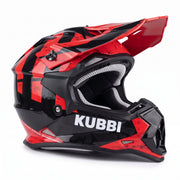
The chin bar. The obvious one. A cycle helmet leaves the face open. On a full-face, the bar is a structural part of the shell and gets tested in its own right — it is not a plastic add-on.
How far down the back it comes. Put the two side by side and look at the rear edge. A cycle helmet stops around the top of the skull. A motocross shell carries on down past the back of the head and wraps the sides.
What the shell is made of. A cycle helmet is mostly crushable foam with a thin plastic skin bonded on, and very large vents cut through it — light, cool, and designed to crush once. A motocross helmet has a proper structural outer shell with the foam liner inside it, which is most of why it weighs what it does.
The peak and the open eye port. The peak keeps a low sun and flying grit out of the eyes. The open eye port is there so goggles can sit in it, which is why a motocross helmet has no visor.
Where a cycle helmet is the right helmet
It genuinely is the right choice for some of what your child rides, and we'd rather say so than pretend otherwise.

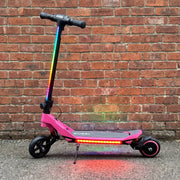
Scooters. A scooter rider stands upright and tends to step off forwards, so the wrists and knees take the impact rather than the chin. The road safety charity RoSPA suggests parents buying a scooter also consider a helmet — a cycle helmet, in their words, is probably best — along with knee and elbow pads and wrist protectors. That is why we point S4 Pro and S7 Pro riders at a cycle-style helmet and a set of pads rather than a full-face.
Balance bikes and pedal bikes. Exactly what EN 1078 was written for.
Anywhere a heavy helmet means no helmet. A full-face that gets left in the shed protects nobody. For short pavement laps on a scooter, the lighter helmet that actually goes on their head is the better helmet.
Where we'd go full-face instead
Three things change the maths, and an electric dirt bike brings all three.
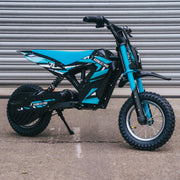
There's a throttle. Speed is no longer set by how hard a child can pedal. Parental speed controls take the edge off that — the K4 has a low mode at 8 km/h a beginner can stay on for as long as you like — but a throttle still delivers more than legs do.
The ground is uneven. Grass, ruts and mud produce the kind of fall that goes forwards over the bars rather than sideways onto a hip.
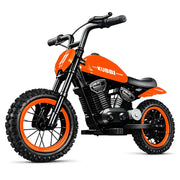
The riding position is lower and more committed. A rider seated on a K7 Pro or a K10 Pro has their face much closer to the handlebars than a child standing on a scooter does.
None of that makes a cycle helmet useless, and we would never tell a parent their child cannot ride until a new helmet arrives. It does mean that if you are buying a helmet specifically for a dirt bike, the full-face is the one we would buy.
Not sure which helmet your child needs? What Helmet Does My Child Need for an Electric Dirt Bike? covers certification and how to check a helmet is what it claims to be.
What a full-face costs you
Worth being straight about, because every parent notices these in week one.
It's heavier. Our shells are built for children's heads rather than scaled down from adult ones, which helps, but it is still more helmet than a cycle lid.
It's warmer. Less of an issue on a cold morning than you'd think, and the vents do work, but on a hot afternoon they will want it off between runs.
It muffles you. Agree your hand signals before the first ride rather than shouting across a field.
Most children stop noticing all three within a session or two. The ones who don't are usually in a helmet that doesn't fit properly, which is a different problem — our helmet size guide has the checks to do when it arrives.
Frequently asked questions
Is a motocross helmet the same as a motorcycle road helmet?
They are close cousins, and the difference is in the face. A road helmet has a visor and a smaller opening; a motocross helmet has an open eye port for goggles and a peak for sun and flying grit. For an off-road bike, the motocross shape is the one you want.
My child already has a cycle helmet. Do I have to replace it before they ride?
No. It is a certified helmet and it is doing a job. For dirt bike riding we would recommend moving to a full-face when you can, and we would recommend it more strongly the faster the bike goes.
Is a motocross helmet overkill for a scooter?
For most scooter riding, yes — we would put them in a cycle helmet and a set of pads. If the same child rides a dirt bike as well, it is perfectly sensible to own one of each and use the right one.
Does a cycle helmet need replacing after a knock, the same as a motocross one?
Yes. Both protect by crushing, and once the foam has crushed it has done its work. Any helmet that has taken a real impact should be replaced whatever standard it is built to.
Will a full-face be too heavy for a four-year-old?
It is the first thing parents ask, and the answer is in the fit rather than the weight. A helmet shaped for a child and sized correctly sits balanced on the neck; one that is too big rocks forward and feels twice as heavy as it is.
Do goggles come into it?
They do, because the eye port is open by design. We treat them as recommended rather than required — the reasoning is in the helmet guide.
The bottom line
A cycle helmet is approved to a standard written for pedal cycles and skateboards, tested at about 5.4 to 5.5 metres per second, with nothing in front of the face. A motocross helmet is approved to the motorcycle standard, tested at 7.5 metres per second and above, with a chin bar that is tested in its own right.
Match the helmet to the machine. Scooter and balance bike, cycle helmet. Electric dirt bike, full-face. If your child rides both, owning both is not extravagance — it is just the right tool each time.
Kubbi supplies electric bikes and scooters to over 15,000 UK families. Everything ships from our own UK warehouse with a 12-month warranty and spare parts held in stock.