


Quick answer: The gap between a £120 "kids electric dirt bike" and a real one isn't branding. It's the battery chemistry, the wheels, the brakes and whether anyone sells you a replacement part when something breaks. A cheap one can genuinely be fine for a few months. The question worth asking is what happens in month nine, and most of the cheap listings quietly answer that for you by having no spare parts at all.
This guide is the set of checks we'd use ourselves. They work on any seller, including us.
Want the short version? Lithium battery, air-filled tyres, a stated max rider weight, a named warranty and spare parts you can actually buy. If a listing is missing more than one of those, keep looking. See the Kubbi range →
Why the cheap ones are cheap
Nobody is selling you a worse bike out of spite. A £120 bike costs £120 because four specific things have been taken out of it, and each one is invisible in a product photo.
The battery. This is the big one. Cheap ride-ons usually run sealed lead-acid batteries, which are heavy, slow to charge, and lose capacity quickly — often noticeably within a year. Lithium costs more up front and holds up far better. If a listing doesn't say the word "lithium", assume it isn't.
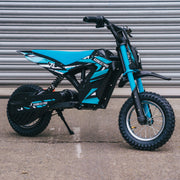
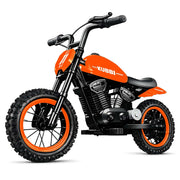
The wheels. Hard plastic wheels are cheap to make and fine on a smooth patio. On grass, gravel or anything uneven they skid, they transmit every bump straight into the child, and they're the main reason a bike gets abandoned after a fortnight. Air-filled off-road tyres grip and act as suspension. A K4 runs 12-inch pneumatic tyres for exactly that reason.
The brakes and the throttle. Cheap bikes often have one crude brake and an on/off throttle, which is a bad combination for a nervous beginner. What you want is progressive power and a brake that scrubs speed smoothly. Parental speed controls matter too — a bike with one speed is either too fast on day one or too slow by month three.
The frame. Look for a stated maximum rider weight. If a listing doesn't give one, that's usually because the answer is unflattering. It's the single quickest way to tell a toy from a bike.
The question almost nobody asks

Here it is: if the throttle fails in March, can you buy a new one?
This is the difference that actually decides whether a bike lasts two years or eight months, and it's almost never mentioned in reviews. Children crash bikes. Throttles wear out, inner tubes puncture, kickstands snap, chargers get stood on. None of that is a defect — it's a bike being used.
On most cheap listings, there is no answer. The seller imported a container, sold it, and moved on. One broken throttle and the whole bike is landfill, which turns a £120 bike into £120 for eight months of riding.
We list spare parts individually, by model, because we'd rather sell you a £30 throttle than a new bike: 15 parts for the K4, 20 for the K7 Pro, 28 for the K10 Pro and 71 for the K22 — batteries, motors, controllers, tyres, brake levers, chargers, kickstands.
You don't have to buy from us. But before you buy from anyone, search their site for the word "spares". What comes back tells you most of what you need to know.
What each price band actually buys
Rough bands for the UK market, and what tends to be true inside each one.
| Band | What you typically get | Watch for |
|---|---|---|
| Under £150 | Lead-acid battery, plastic wheels, single speed, no stated rider weight | No spares, no UK support, short battery life |
| £150–£250 | Mixed. Some lithium, some still lead-acid and plastic | Read the spec, not the photo — this band hides the biggest gap |
| £250–£450 | Lithium, pneumatic tyres, two or three speed settings, real warranty | Check the height range as well as the age range |
| £450+ | Bigger motor, suspension, more range, bikes an older child grows into | Easy to buy more bike than the child can handle |
Our range starts at £289.99 for the K4 and runs up to the K22 for teenagers. We've deliberately got nothing under £250, because we couldn't build something at that price we'd be happy putting a child on.
The maths that actually matters
Compare a £130 bike that stops working in month eight with a £289.99 one that's still going in year two, and the cheap one is more expensive per ride. That's the obvious version of the argument and it's true, but it isn't the part that stings.
The part that stings is that the cheap one usually fails in the middle of the thing it was bought for. It doesn't die quietly in the shed in September. It dies on a Saturday in February with a child standing next to it, and the honest answer is that it can't be fixed.
We're careful about what we promise here too. A K4 fits a child for a couple of years, not forever — they outgrow it, and when they do we'd rather they move up to a K7 Pro than discover the whole thing was disposable.
Six checks before you buy anything
Works on any listing, from anyone.
1. Does it say "lithium"? If the battery type isn't stated, it's lead-acid.
2. Are the tyres air-filled? "Pneumatic" or a stated tyre size in inches is a good sign. "Durable wheels" is not.
3. Is there a maximum rider weight? A real number means a real frame. No number means nobody tested it.
4. Can you see the spare parts? Not "contact us for spares" — an actual list with prices.
5. Is there a height range, not just an age range? Age is a rough proxy. Height is what decides whether their feet reach the ground. Ours are on every product page, and the Fit Finder will do it for you.
6. Who answers the phone? Find out before you need to, not after.
Frequently asked questions
Are cheap kids' electric dirt bikes safe?
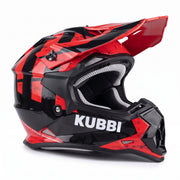
Not inherently unsafe, but the things that get cut tend to be the things that keep a beginner in control — progressive throttles, a second brake, grippy tyres and parental speed controls. A helmet matters more than the badge either way; What Safety Gear Does My Child Need? covers the kit.
Is a cheap one a good way to see if they'll stick with it?
It's a reasonable instinct, but it tends to backfire. Plastic wheels on grass are genuinely not much fun, so a cheap bike is as likely to tell you they're not interested as it is to tell you they are — and you'd have learned the wrong thing.
What about a used one?
The problem is the battery. It's the most expensive part, it degrades with age and charge cycles, and you can't inspect it from a photo. You're buying the one component with a hidden clock on it.
What's the realistic minimum to spend?
Around £250 is where lithium batteries, air-filled tyres and a proper warranty start appearing together. Below that you're usually paying for something that looks like a dirt bike rather than works like one.
Do you price match?
No, and we'd be wary of anyone matching a £120 bike's price, because the only way to get there is to take something out.
The bottom line
Cheap isn't the problem. Disposable is. A bike you can't get a throttle for isn't a bargain, it's a deadline.
Run the six checks on whatever you're looking at. If it comes back with lithium, air-filled tyres, a stated rider weight, a real warranty and a spare parts list you can click on, you've found a bike worth buying — wherever you end up buying it.
Browse the Kubbi dirt bike range →
Kubbi supplies electric bikes and scooters to over 15,000 UK families. Everything ships from our own UK warehouse with a 12-month warranty and spare parts held in stock.